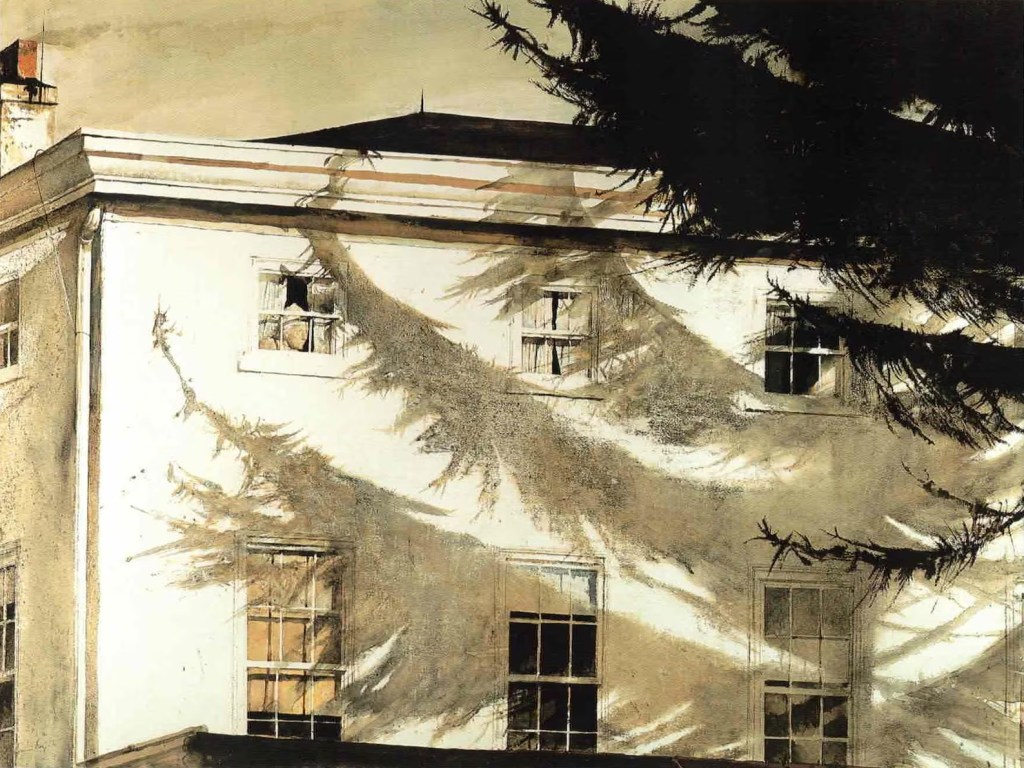
Tree House by Andrew Wyeth

Hello! This is the first installment in the Ekphrasis Project. For each of these stories, I will find one piece of art, write one story set within that piece of art, and write the story in one hour. Enjoy!


Alex woke up first.

“Let’s practice fencing.”

We started a quiet game of fencing on the stairs. I am getting very good at taking the high ground from Alex. He took a tumble in the first round, but he’s so nimble, you could barely hear it. In the second round, I tripped on some shoes (Sara and Lizzie keep leaving theirs everywhere) and, while not nearly as light as Alex, still managed to land at the foot of the stairs with nary a thump. 1-1. Alex met me halfway and we began again, our rapiers clashing as we began again.

“Boys! Stop that right now!” A voice growled. A ghost glared at us from the second floor landing, clad in anger and an awful white nightgown with ruffles. Oh.

“Grams, we’re practicing our fencing,” I explained.

“No. Outside. Both of you.” We started down the stairs. “And those broomsticks are not for fencing with. Put them back in the closet.”

A half hour later, we returned for breakfast: bacon, sausages, eggs, biscuits, and little trays of fruit. Alex and I were having a passionate discussion of the merits of slingshot stone sizes, large vs. small and round vs. flat. I really felt that I was getting through to him about flat stones and used a bit of bacon to make my point about shape. He replied that shape did not matter unless you had a good deal more heft and proceeded to demonstrate his point with a sausage.

“Silence!” Grams again. Sara and Lizzie paused mid-biscuit. “We do not raise our voices at the table and we do not throw sausages at each other.”

“But, Grams, slingshots-

“No. Outside. Both of you.” She waved a long, white hand like a wing, brushing us out the door.

While the ladies finished breakfast, we completed our argument with demonstrations on an obliging tree. This took up some time, given that whenever one of us wanted to go and find the rock he had originally used, the other would pelt him with theirs as a way to demonstrate their argument’s effectiveness. We both had several bruises by the time we called truce.

“Betcha can’t ride Fat Martha,” Alex said.

“Anyone can ride Fat Martha,” I said.

“Across the entire yard and back?”

This brought me up short. Fat Martha was old and greying. She never lifted her head except for food.

“Of course I can,” I said, not to be deterred. Alex was all talk. Not me.

We checked to see if Grams was watching from one of the many windows. All clear. We crossed the yard to Fat Martha’s pen and I dangled an apple to get her attention. As she wrapped her thick lips around it, I clambered aboard.

“See? Told ya!”

“You’re not riding. You sitting. Across the yard and back, remember? ”

“I just have to get her moving.” I began coaxing Fat Martha the best I knew how: insults. She was fatter than the moon, or one of those big blocks of cheese from Switzerland. She was so huge, she blocked out the sun. Then I tried compliments, comparing her white derriere to the softest of marshmallows. She snorted.

“Try kicking her,” Alex said. So I did. And while I kicked, the girls came around the house, yelling about something, and Alex slipped inside the pen to give Fat Martha a slap on the rump.

“Alex!”

What they don’t tell you about fat ponies is that they have quite a bit of energy stored up. Fat Martha took me across the back yard and back, and then across and back, and then across and back again, zigzagging like a crazy bee. Alex and the girls came after us, trying to catch her while I tried not to fall off. finally, she stopped and I went flying over her head to land in a heap.

I looked up. The ghost of this morning was a veritable harpy now, all red-faced and enraged. Grams glared at me before jerking a finger.

“Tree house. Now. Both of you.”

Alex and I both went off to the front of the house sulking. The tree was a patch of stacked lumber up in a big tree that was supposed to be a beautiful house to play in, at least if Dad ever got around to building it. Grams sent us there whenever she couldn’t put up with us.

I could see her now, looking across from her window. Her face was tight and grim, an old owl in her own big tree house.

“Do you think she’s really mad?” Alex asked.

“Maybe.”

“Do you think Mom and Dad are coming back?”

“Yeah.” Although I wasn’t sure.

“You looked ridiculous on Fat Martha.”

“Shut up, Alex.”

Doomsday

Photo by Max Ravier on Pexels.com

After a three month delay, it was finally time. Following a night of very deep rest, he went for his early morning swim with his personal trainer, ate a hearty breakfast prepared by his chef, donned his freshly laundered white pants and shirt, said good morning to his compound manager, and then entered his private control room.

Sliding into his ergonomic chair, he took a moment to enjoy the sunlight pouring into the space. The big windows had been a suggestion of his new compound manager who took over right after the terrible debacle with the previous staff.

No more delays. Today he would open the program, conquer his enemies, and drink that bottle of Scotch. He switched on the computers and his AI, and then flipped the switch for the bots’ underground bunker to ‘Open’.

“Good morning, sir.” His AI assistant’s voice was light and feminine, something he felt he needed when the previous staff proved to be so treacherous. It made him feel more cheerful.

“Open Doomsday,” he said.

“Doomsday is opened. What city would you like to hit with Doomsday?”

“Los Angeles.” He wanted all of those acting coaches to know that he had succeeded at something without their help.

“Los Angeles Doomsday commencing.” The bots would go after the dumpsters first, setting everything on fire. He could see it now. The Los Angeles Dumpster Fire. One Hot Mess. Hahaha.

He made himself a cup of coffee and then sent out the other two flotillas of bots, one to Hong Kong and another to Paris.

He had applied for a fellowship in Hong Kong as a young grad student and was rejected on the basis of his thesis being “interesting and informative, but not quite a fit for our program.” Hong Kong could sink into the ocean for all he cared. By the end of the day, it might.

His last girlfriend had broken up with him along the Seine. It was supposed to be the most romantic night of his life. But instead she had called him a selfish know it all who could never love anyone. That city would be a pile of romantic rubbish when the bots were done with it. Hot Parisian Trash. No, Haute Parisian Trash. Hahaha.

Outside, the pool boy cleaned while the maids walked by with the laundry. They waved. He nodded back, not wanting to appear rude. They were all still new to the island, brought in by his compound manager after the last group had tried and failed to destroy his nanobots. Very unkind of them.

He finished his coffee with a loud, appreciative sigh. “Show me the Los Angeles Doomsday.”

The screens flickered. He gripped the chair arms in excitement. Yes, show me smoke and destruction. Show me people fleeing the scene with their designer handbags. Show me choppers crashing into tall buildings.

“Los Angeles Doomsday loaded.”

The screens sprang to life. Palm trees swayed in a gentle breeze. The skyline almost shimmered in the late morning light. People strolled the clean streets, all looking surprised and- wait, did they look happy? Where was the trash? The fire? The car wrecks?

A news report flashed up on one of the screens. “A swarm of what looked like bugs appeared on the horizon about an hour ago and since then the city has transformed. People are sharing videos of what many are calling The Miracle on social media. These little bugs are cleaning up trash, filling in potholes, and in several cases rescuing dogs and cats.”

“What?”

“One resident reported a small fire that could have turned into a deadly wildfire. These little guys put it out before anyone else noticed it. And you might notice that our smog appears to be clearing. Specialists have not idea what this swarm is, but it’s doing incredible work. Happy Miracle Day!”

“No!” His coffee cup bounced off of the bulletproof glass. “No no no!”

“Is this Doomsday not to your satisfaction, sir?”

“NO!”

It got worse. Hong Kong was clean and shiny, every dock free of trash and grime. Citizens removed their air filtration masks in triumph and set them neatly in recycling bins. Several parades formed as people peacefully followed the swarm of bots around the city, phones lifted to chronicle the event. A wedding reception spilled out onto the street and turned into a rave. Dolphins leapt in a newly cleaned harbor.

“This is the worst Doomsday ever!”

And then there was Paris.

Schoolchildren wandered up and down the streets trying and failing to find any trash bags. A bunch of workmen poked their heads out of the sewers to tell everyone that it was beautiful down there. “Like a gleaming grotto! No sludge in sight!” Couples made out on every bridge and street corner. The entire city had forgotten to smoke, they were so thrilled.

“I hate the French.”

The French president and his cabinet came out of a meeting upon hearing the news. A modeling shoot had been taking place up the street from them in the magic hour lighting of early evening. Both parties met on a bridge above the Seine to see if the rumors about the bots were true. The president was so overjoyed that he took two models by the hand and jumped into the blue, blue river with them, suit and gowns be damned. The French newscasters kept bringing up a photo of that group floating in the Seine like children at a pool party.

“NO!!!!!”

He let the screens run, all of them hopping back and forth to show footage of the miracles his bots had wrought. He tried to go back to his previous iterations of Doomsday, the glorious ones with all of the exploding buildings and cars (and acting coaches, former girlfriends, and department heads).

“Pull up access codes,” he said.

“Pulling up access codes,” the AI said. He was beginning to hate that chirpy voice of hers. “Scanning eye.” A subtle beep as it scanned his eyes. “Eye scan access granted.”

“Good.”

“Scanning thumbprint.” Another beep. “Access denied.”

“Next scan,” he said through gritted teeth. The last group of workers had made him very nervous with their attempt on his bots. He had made his next round of AI security a seven step process so no one could ever break in and change it. The AI scanned his nose, then the inside of his left ear, then the back of his hand, bottom of his right foot, and, finally, his navel. All of the scans came back denied, even though he had just checked them last night before he went to sleep for so long. How could this have happened?

“Um, excuse me? Knock, knock!”

It was his compound manager.

“Everything all right in here?” The compound manager stopped at the sight of his boss in front of all the screens showing Doomsday. “Oh my!”

“It isn’t what it looks like,” he found himself saying. He was so ashamed. “This was all supposed to go really differently—

“Everyone get in here this instant!”

The pool boy, the two maids, the chef, and the personal trainer were soon assembled, all leaning in through the door at first. And then, they were all clustered in front of the screens.

“Boss,” the compound manager said in awe, his strong hands clasped in front of his bespectacled face. “Did you do this? Are those your bots?”

“They’re beautiful,” the older of the two maids said, her button nose crinkling as she smiled. ‘“I had no idea.”

“Like, so cool,” the younger one agreed. She’d tied her blouse up to show off her navel piercing. He had always found her a bit ditzy, but the way she said this last comment seemed to bely her air-headed nature.

“Thank you,” he found himself saying.

The pool boy gave him a fist bump and a nod while the personal trainer pulled an earbud out of his left ear, leaned in, and said, “What a champ!” The chef was so excited that he tripped over a cable and ended up giving his boss a lopsided hug while balancing on his right foot.

“Great work, sir,” his compound manager said. Behind him, in the early afternoon sun, the bots were returning in a swarm of annoying goodwill. “What do you call this program?”

“Uh, Doomsday,” he said. He looked down, not sure what to say. His whole staff exchanged side glances and several yawns before snapping back to attention.

“Doomsday,” the older maid murmured.

“That is, like, super meaningful, right?” the laundry girl said.

The compound manager nodded. “I think it speaks to both our understanding of doom and also to, well—

“The existential crisis of facing a world without the every day problems we feel define it and us,” the pool boy said. Everyone stared him. “What?”

Their boss had been misunderstood completely, but in this moment it felt as though everyone was really trying. It was strangely moving how these people of far lower intelligence could touch him so. And they did look tired. Had they slept last night? He wondered if he was overworking them. He’d been in a job like that before: demanding boss, long hours, no vacations. And they were all being so very appreciative of a project that had gone so terribly wrong. Tomorrow, he’d see if his compound manager could figure out a way to make sure they all got some much deserved time off.

He went over to his desk. “I was saving this for a special occasion, but maybe now is a good time for it. Scotch, anyone?”

The Elevator

He noticed her smile first.

Everyone else who rode to the 109th floor resembled the panes of clear, elevator glass: aloof and bulletproof. She, however, was a glowing orb, crackling with energy in her lavender dress. He could burst into flames standing too close.

She hummed a slow and soulful tune most days while the others stayed silent. He thought of asking what it was. But no. She had no reason to notice him, a lowly elevator attendant. That was best.

Sometimes, she slipped through the lobby elevator doors right as they were closing, green eyes wide, hair flying, whirling dress almost catching between the doors as the yells of angry protestors echoed behind her. She always looked up at him, a wordless laugh escaping as though the two of them shared a secret joke. He wished things were different.

Questions about the top floor were forbidden. He needed this particular job for the family, so he kept quiet. But every day that she slipped through the doors at the 109th floor with its scanners and intense security, he wanted to ask her how she spent her time.

The head of the top floor could have been anyone. They all wore dark suits and misery. She slipped in and out like any of the other secretaries, pastel purpose in a dreary landscape. He wondered sometimes if she was like him, a quiet soul creating a new world. How did she survive the brutality upstairs and the constant din of rebellion below?

For months, he endured the unanswered questions. Then one day, he arrived at the 109th floor earlier than usual, the elevator doors blinking open silently as planned. No one noticed him.

She was at the front desk, keeping busy with a slight smile on her red lips. One of the dark suits gave her a slight bow. “Mademoiselle.”

His heart caught.

“Make sure they have those protestors cleared by 6:30.” Her voice was a bullet. “Don’t make me repeat myself.”

“Of course, Mademoiselle.”

She slipped off a bracelet loaded with keys into a drawer, an elegant flash of silver and bare skin. Papers were passed to suits and secretaries. He averted his gaze. The elevator dinged, as though only just arriving.

He ferried all of them down, shutting the door before she could slip through the gap. When he returned to fetch her, she gave him that look of breathless excitement, as though she’d been waiting for him. He felt his heart thud against the key and the 3-d printed gun in his breast pocket. His courage nearly bled out of him. The family was waiting.

Photo by Ryutaro Tsukata on Pexels.com

She noticed his hands first.

Limp handed suits accompanied her everywhere. Secretaries took her orders dressed in delicate pastel. Her world was everything that was soft and refined and cruel, silk shrouding verbal swords. Calluses were non-existent.

But his hands were strong, lined by life. She glanced through his file more than once that first week. She had it memorized within two days: the blue collar jobs, the military service, the degree from a forgettable university.

The hint of a tattoo poked out of his suit collar. While her suits and secretaries argued over company presentations and the latest downstairs protests, she doodled what she imagined the rest of it looked like. One day it was a snake wrapped around an anchor (a nod to his naval career). Another day it was a gun sprouting flowers (he seemed the sort to garden). At the end of the month, (while she listened to a boring talk on the possibility of terrorism), it was a cat.

Sometimes she waited until everyone else had left before getting on the elevator. The suits advised against this, saying it would tip off protestors to her identity. Other CEOs leave first, she assured them. This is good cover.

She could stand alone in the elevator and look at his shoulders. Could they hold the weight of everything she never found the words to say?

Maybe it was the twenty-fifth day of protestors throwing rotten fruit at her. Maybe it was when the suits told her the truth about the fudged numbers and the realities of the warehouses. Maybe it was when she imagined him going home to an ordinary life.

Whenever it was, she wanted out.

Escape planning took two days. At the end of the second, as she sent everyone home, pulled out her resignation letter, slipped that annoying set of keys off her wrist for the last time, and waited for the elevator.

She’d seen him look at her. It would be no trouble at all to get him to take her secretly from this building. She hummed as they descended, the crowds dispersing below them exactly as she had planned.

In a flash of silver and tattooed skin, the elevator stopped at floor 76., the abandoned floor. She looked up, surprised.

“You are coming with me, Mademoiselle.” His voice was calm, even soothing. “My family has some questions for you.”

The elevator shut behind them.

The Girl and The Red Ptarmigan

Photo by u00deorsteinn Friu00f0riksson on Pexels.com

When the box arrived, it was covered in white ribbons. Thrrrrp! A chirrup sounded from within, insistent and indignant.

When the girl opened the box (or rather, when the box nearly tore off its own wrapping), a feathered head thrust its way out.

“Oh!” her mother exclaimed. “Your ptarmigan looks a bit, uh-

“Pink,” her father finished.

The girl didn’t know what her parents meant. Her ptarmigan was clearly red, not pink at all. Its dark eyes gleamed. She scooped it up and went outside, smitten.

They played in the snowy garden for hours. The ptarmigan liked to do hesitant flaps as the girl ran around it in circles. When she wasn’t running, she sang to him while he twittered to her. When he chirruped for food, she brought him inside to the kitchen and pulled out small, seed biscuits. But her ptarmigan arched its face away, disgruntled.

“What do you want?”

The ptarmigan wiggled its head at a row of sausage hanging in the cellar. The girl had never heard of a ptarmigan who liked meat. But her ptarmigan did look very hungry. She broke off several links. The bird chomped and swallowed, then bobbed for more.

“You are going to be the biggest and most beautiful ptarmigan,” the girl said. “A giant ptarmigan.” The ptarmigan cooed and settled in her arms, asleep.

The next day was their first ptarmigan class. The girl arrived a bit late. Her ptarmigan had resisted the straps of the leash. It didn’t matter. It was worth it to strut past her classmates to the end of the line, their mouths agape while their own ptarmigans looked about as impressive as dirty snow.

Ptarmigan school proved to be difficult. The other ptarmigans walked neatly through the snow, hardly leaving footprints. Her ptarmigan jumped and danced, leaving a thick track of strangely shaped prints. The other ptarmigans stood stock still during camouflage practice. Her ptarmigan ducked itself into a snow bank, dusty red tail feathers shaking in the air.

The girl giggled. Her teacher frowned.

“Your pink ptarmigan must learn to behave. It needs to eat its daily allotment of seeds, respect the leash, and stop trying to run off.”

The girl wanted to object. Her ptarmigan did not like seeds. They made him sick. If he left the line, it was only because he was investigating his surroundings. He always came back. And he wasn’t pink. He was red.

But her teacher’s stern look silenced her.

For the next two weeks, she did as ordered. Her ptarmigan choked down seed biscuits, and then choked most of them back up in a wet blackish pile. He twittered too loudly, so he was muzzled each morning before being dragged to class on the leash. If he tried to move out of the ptarmigan line in class, the girl gave him a swift swat. She even dusted his feathers with flour so that he was not so noticeable amongst his cloud white classmates.

Her teacher nodded in approval.

The girl, however, cried every night.

At the end of two weeks, her parents found her in the kitchen next to the biggest oven with her ptarmigan in her arms. The bird lay limp, barely breathing. His eyes were dim and half closed. Swaths of red feathers had fallen out, leaving behind scabs on his skin.

“I’m sorry. I’m so sorry. I don’t know what to do,” the girl sobbed. “I did everything they told me.”

Her mother laid a gentle hand on her shoulder. “I think he knows what he needs. So do you.”

“But he isn’t like the other ptarmigans.”

“Who cares about them?” Her father said. “He is your ptarmigan. You get to decide what he eats and what he does.”

“Yes,” her mother agreed. “What can we give him?”

The girl wiped her eyes and cradled her ptarmigan. “He needs meat. A lot of it.”

The girl stayed home from ptarmigan class the next day. She nursed her red ptarmigan with squares of raw meat, blood dripping from her fingers, and slept with him nestled in her arms by the kitchen ovens. She sang happy and sad songs to him, depending on her mood. He cooed and chirruped more and more as the days passed.

Finally, one day, his feathers began to come back in, a soft rusty down. The snow melted outside their strong, stone house. The girl strapped him to her chest and took him for long walks in the sunshine.

One day, they came to a bright, sunny field. He twittered to be let down and scurried all over the muddy ground. He flapped his wings, no longer the soft rust, but now red-gold, a ruby caught in a bonfire. A wind gusted towards them and suddenly he was aloft. He chirruped in triumph.

“You are no ptarmigan,” the girl said as he hovered over her, testing his wide wings. The bright spring sun behind him cast a fluttering shadow on the girl’s smiling face. “You are a phoenix.”

They never went back to ptarmigan school.