New Year’s Day can be a time for more celebration. For me this year, it has been a day of rest from my illness. I did manage to take a short walk at my favorite park, and then also caught up on some house tasks. It felt like the sun had come up after a week of darkness. Even accomplishing the simple task of peeling potatoes and putting them in the oven made me smile.
New Year’s has often felt like a holiday just for me because it is all about dreaming for the future and planning what I am going to accomplish. Dream big, right? Make those vision boards! Just. Do. It.
This year, though, I felt myself quiet and slow down, partly because I had to, and partly because I wanted it. I’ve been reading the biography of Dallas Willard and he is the perfect company for slowing down. I have learned so much from this man’s example and his work. Not just about philosophy and theology, but more about living in the kingdom of God in the here and now.
One of my favorite parts of the book comes at the end in this quote:
I’ve had to learn that the important thing is not what I accomplish but the person I become…What God gets out of my life is not what I accomplish; it’s what I become.
Vision boards and goals can be good things. I find myself doing them out of a lot of guilt most of the time, though. I keep thinking I should do them because other people are and being productive depends on being that person who accomplishes the things on her vision boards and goal lists.
What am I becoming when I refer to those things as my measure of success, though? Someone who relies on a checkmark to give her a sense of worth probably won’t be a good friend. I think if I’m constantly using goals and vision boards to help me through life, I am focusing more on life as a grid, a set of equations to work through and finish. I don’t want my life to be a grid, though. I want it to be a garden where people feel welcomed and able to rest. That’s what I want to become.
I will probably set goals and write them down. I will also probably do a theme around my year and think about I want to explore. I do want to let go of the idea that I have to have big accomplishments under my belt at the end of 2025. I’d settle for someone telling me that I helped them rest, instead.
One of my favorite concerts of 2024 was seeing The Gray Havens. At the time, this song had not officially released and Dave Radford shared with us the struggle that he felt in writing it. “Sometimes I fantasized about quitting my job and going work at a gas station.” (He wrote this song instead, which I think was a great decision) I know for myself, it often feels like if I could just make the right goal list or find somewhere else to be, all of my problems would go away. We cannot see what we will grow this year. How thankful we can that God sees and knows every day of our becoming.
The party that is this illness continues to rage so hard that I can’t leave my apartment else I’d miss all of the fun. Still, even if the party is a feverish one, I can manage a few words about this day.
How glad I am for so many things. I like to think of it as a Reasons To Celebrate List. To me, they shine like candles in what has been a tough week on the health front. I hope they bring some light to yours.
One of my best friends was born on New Year’s Eve, and it always feels like a worldwide party for one of the best people. Happy Birthday, Julie. 🙂
I changed jobs twice this year, both times because I wanted to and put in the work to find a new job. I am so thankful for God’s voice and provision.
I sang with two choirs which was so sweet and good. I also gained a lot more confidence in my ability to harmonize off the cuff.
My novel has an end in sight. I have never had so much clarity about a creative project before and I am looking forward to sharing chapters with Substack in 2025.
I accompanied and performed more in 2024 than I did in the two years previous. It is so good to use music to help others and bring beauty to life.
There is a renewed sense of hope and momentum in my life, a huge relief after a long season of burnout. I am so thankful.
I made new friends and deepened old friendships this year. People make a place, and I am so glad to have some truly extraordinary ones in mine.
Let me know if you make your own list to celebrate this year. And here is a beautiful bit of creativity and love that I enjoy coming back to regularly. A bright light, indeed.
Reading The Dark Is Rising has been both a gift and a challenge during this week. I would have preferred to read the entire thing in one day. Instead, I find myself having to wait and read each chapter like a bit of dark chocolate.
I could use a lot of words to describe Cooper’s writing: clear, creative, or full of hyphenated words like before-breakfast, crossed-circle, and, my personal favorite, snow-burdened. The word that comes to mind most often, though, is clean. There is no wasted word or scene, and many things operate on two planes of meaning. The novel is set in such a short time frame, and yet it feels incredibly rich and fully lived in by the characters. Its season and setting is winter in an English village and I can’t imagine it happening anywhere else.
As I have been reading it, I have been trying to think of other books that use the winter season so very well. Or course, one of the first ones that comes to mind is Little Women. The opening is all about Christmas and sharing what you have. Then, Narnia, obviously. I think the Lion, the Witch, and the Wardrobe can be blamed for my strange and strong desire to have a tea party in the woods every year around this time. (That gives me an idea. More to come)
Here are a few that I wish more people knew.
A War of Gifts by Orson Scott Card- It’s set at a space academy where the children rebel…and that’s as much as I can say.
Hogfather by Terry Pratchett- Ever wonder what Christmas would be like if Death took over? FABULOUS, OF COURSE.
The Tenth of December by George Saunders- This is a perfect short story. The only one I like better of his is Sticks. Don’t read this if you don’t want to cry and question your entire life.
To be honest, I didn’t feel much like celebrating today. This illness has turned into a rough head cold and I have mostly sat around drinking tea and guarding against my fever. Every hour or so, I haul myself outside for sunshine and fresh air before coming back to my nest.
But, not unlike Will Stanton and our other merry heroes and heroines, I believe that there is more than one plane of existence. While outwardly I have this head cold and aching body, yet inwardly I have a great store of joy and peace. The beauty of Christ’s coming is that I do not need to accomplish everything. He has already accomplished it all.
My commemoration today will include a brief walk, followed by more rest, followed by an attempt to play some music. I might even write a story about winter. Even if it’s all just rest, though, it will be enough.
Merry Christmas!
P.S. Whatever you do, don’t ever search the trailer for The Dark Is Rising.
P. P.S. Here is a beautiful piece of improvisation as reward for not searching that trailer. If you did search the trailer, may this music wash you clean.
There’s a story I’ve heard about St. Thomas Becket, the former Archbishop of Canterbury, being martyred at an evening mass in Canterbury Cathedral. As a child, I was obsessed with Henry VIII child and read that Becket was martyred during his reign. I hadn’t realized that it happened in the sanctuary of a cathedral, though.
Because Becket died during what should have been a vespers service, singing carols and praying felt like an appropriate way to commemorate today. (I also added a small glass of wine to the proceedings).
There are so many carols that I love it is hard to pick one. Music is made more difficult by brain fog (I’m still sick). But music is a great force of healing, so the brain fog does not matter as much. Even humming or tapping a rhythm makes me happier and clears the fog away, for a time. There are a lot of old favorites: Silent Night, The First Noel, The Holly and the Ivy, and I Heard the Bells on Christmas Day. I did a lot of singing this December and it always makes the Christmas time that much more special. I wish more people would celebrate the twelve days of Christmas so we could keep singing all of these carols. So many of them express the beauty of Christ’s coming through the lens of different cultures. Silent Night is German, The First Noel is French, the Holly and the Ivy is English, and I Heard the Bells is American. For next year, I would love to research and learn carols from other parts of the world.
Here’s one of my favorite settings of a Christmas carol. This is called the Huron carol, and it is believed to be one of the first songs written by Christians in the New World.
For prayer time, my brain felt foggy still, so I opted to use Douglas McKelvey’s Every Moment Holy to help me focus.
Two of my favorites prayers that I used tonight are from his Sundry Moments section. I prayed this one for members of my family.
God, as I hold ______ a moment in my thoughts
I ask that you would hold them eternally in Yours,
remaining ever at work in their heart and life,
even now directing their paths toward Your good ends.
This one is for being moved by a song or a piece of music. It felt very appropriate for a night where I sang carols and listened to choirs.
O Lord, let such melodies penetrate my heart’s defenses,
gently revealing old wounds unto their eventual healings,
gently stirring eternal longings unto the restoration of hope.
Tune my heart, my mind, my life,
to voice your melodies, O God.
I hope this day finds you well and still celebrating the birth of our Lord. Merry Christmas!
“We remember today, O God, the slaughter of the holy innocents of Bethlehem by King Herod. Receive, we pray, into the arms of your mercy all innocent victims; and by your great might frustrate the designs of evil tyrants and establish your rule of justice, love, and peace; through Jesus Christ our Lord, who lives and reigns with you, in the unity of the Holy Spirit, one God, forever and ever. Amen.”
The Feast of Holy Innocents is a tough one. Like the imprecatory Psalms, it is a day that can lead me to dwell on the darker parts of humanity and the more confusing parts of trusting God. Why throughout all of history do we see innocents murdered? And why does it seem that God does nothing?
Very big questions that I wish I had answers to. As I thought about honoring this day, I knew I wanted to do something that reminded me of innocence and also what the day itself commemorates.
I opted to watch the movie Klaus first. This has been a yearly ritual for me since it came out in 2019. For those of you who have never seen it, here is a trailer.
I love the animation style of this film, the buddy comedy between the postman and Klaus, and the way it portrays and encourages childlike innocence. One of my favorite exchanges is when the postmaster has to help a girl who does not speak English. I can’t say more without spoiling it. Whenever I watch this film, it reminds me that being kind and selfless does not come naturally to any of us, but it is something that we can learn and practice until it is a habit.
The second movie I chose for honoring this day was The Prince of Egypt. This one shows another murder of innocents: the slaying of the Israelite babies during the time of Moses. It’s a beautiful film marked by many instances of death. The first time I saw it, I was very young and we were in a Brazilian movie theater. Everything was dubbed, if I recall correctly, except for the songs. I could still follow along, though. When the song There Can Be Miracles came on, I remember feeling like I was going to cry. Even if I didn’t understand all of it back then, I knew it was a song about freedom.
The first character other than the leads that this song focuses on is a young girl who takes her grandmother by the hand and leads her toward their future. I can think of no better way to express what celebrating innocence looks like. This girl does not know where they are going. She only knows that this is the direction of freedom and in the purity of her belief she goes forward.
I still can’t listen to this without crying, which is also appropriate for today, I think. Honoring a feast day doesn’t mean you have to find a reason to smile. May we all look to the innocent ones in our lives and learn from their example what hope and faith can look like.
I had planned to celebrate the feast of Saint Stephen today, and then discovered that it is actually supposed to be Saint John. Unless I to use the Orthodox calendar, in which case it is still the Feast of Saint Stephen. Naturally, rather than choosing between two saints, I went with celebrating both.
My original plan involved drinking wine with friends and dropping off donations. I was going to listen to good music and dance around the kitchen. However, I woke up sick and have spent most of the day in bed. It can be hard to celebrate when you feel more like sleeping for the next two days. Christ is the great healer, though. I am not feeling well and I can still meditate on the fact that He has come to redeem everything, especially my sick body.
When I had a bit more energy, I read over the account of Stephen’s death in Acts. I was struck by how much detail Luke brings to his account. In story telling, writers talk about a scene carrying its weight. You want dialogue and action in the scene to do more than one job. If it’s only doing one thing, it isn’t very interesting.
The account of Stephen’s trial carries its own weight and more. First, it establishes the history of Israel and why Stephen believes that all of it points to Christ. Second, it establishes why the leaders disagree with him and find him so dangerous: if he is right, they murdered the Messiah. Third, it sets up the violence to come by telling us about Stephen’s murder at the hands of the priests. Luke seems to be saying, “Make no mistake, reader. These ideas are dangerous.” Fourth, it introduces us to Saul, later to be called Paul. He is the most unlikely side character in this scene to do anything for Christ, and yet the book of Acts follows him and his ultimate conversion closely. It’s very good storytelling.
As Stephen is dying, he prays for the people who killed him. When I was younger I wondered how Luke could have known about that since he wasn’t there. But Paul was there, and he must have told Luke all of it. I wonder what that must have been like for him.
St. John is a bit different. He lost so many friends to deaths like Stephen’s, and managed to outlive them all.He endured imprisonment on a lonely island and also had to write down one of the strangest prophecies in Scripture. Say what you will about prophecies all being weird. This one is very long and very odd. He was so faithful, though, all the way to the end, in spite of the strange visions and the lonely island. I hope I can love Christ like that.
My day of celebration didn’t involve drinking wine with friends. Instead, I thought about two men who died many years ago. I still drank some wine, but the day felt somber. Maybe that’s the point, though. Not all feast days have to be full of laughter and charcuterie boards and Yule logs and dancing. They can also involve a simple prayer and a simple glass of wine.
Last year some friends of mine invited me to a small, impromptu Twelfth Night gathering. There were only four of us, and we had the merriest time playing games and talking about our new year. We turned off all the lights and watched as a cake was doused in rum and then lit aflame with a sudden whoosh.
It put me in mind of how there is so much joy in observing rituals. It is a power I do not wish to ignore. This year, I have decided to celebrate the twelve days of Christmas by doing something special on each day leading up to Twelfth Night.
I often have trouble celebrating. There is a little voice inside that whispers, “You can do more work when this is done.” It makes me want to rush through and not savor what is in front of me. As a result, this practice of drawing the celebrating out for nearly two weeks is a tough one. I have decided to try and celebrate in some small way many things that Christ has redeemed by his coming to earth.
For Christmas Day, I went to a morning service at my church. This was not how I was raised. We had church on Sunday during Christmas Week, but not the day of Christmas. There may have been some reminder of Christmas coming, with carol singing and a focus on a passage from one of the Gospels.
This year, though, I had weeks of Advent readings poured over me, the better to sit and soak. At Lessons and Carols the night before, I felt deeply that Christ is real and present, a light shining in what often feels like a very dark and desolate world. We sang a song about the day of peace that dimly shines ahead of us. It felt very near this year. There was a flame lit inside everyone at the Christmas service the next morning. It stayed with me all day.
I celebrated with friends over a long brunch. We had eggs, pão de queijo (Brazilian cheese puffs), coffee, and scones. Then gift giving, memory sharing, and a shared contemplation of Christ’s coming. This was followed by the most beautiful Yule log I have ever seen and small glasses of brandy. T’was a good celebration: rich, delightful, and deep.
Today, the second day of my Twelve Days of Christmas, is what is traditionally known as Boxing Day. I used to picture men in boxers swinging punches at one another accompanied by the deep baying of boxer dogs. “Boxing Day”. I was wrong. Boxing Day comes to us from the practice of boxing things up and giving them to people. There is also record of staff for English aristocracy having the day after Christmas off. This was when they received their “boxes” or gifts.
Today, in the spirit of this Boxing Day practice, I went through my closet and drawers and chose items to donate. It was a good reminder: whenever I give something away it is only because Christ has given it to me first. I do not have to be afraid of giving things away because in Christ there is all the abundance I could ever need.
I also have one book that is providing structure for me: The Dark is Rising by Susan Cooper. Someone mentioned this as a book to read during the Twelve Days because it is set during the winter in an English village. It also has thirteen chapters. I started it on Christmas Eve, and have read one chapter a day since then. I like having it as a sort of prop because reading only one chapter a day works against my usual inclination to eat a book of this size in one glorious, reading soaked afternoon. I also have more time to sit with what Susan Cooper is doing through the story. I look forward to writing more about it at the end of the Twelve Days.
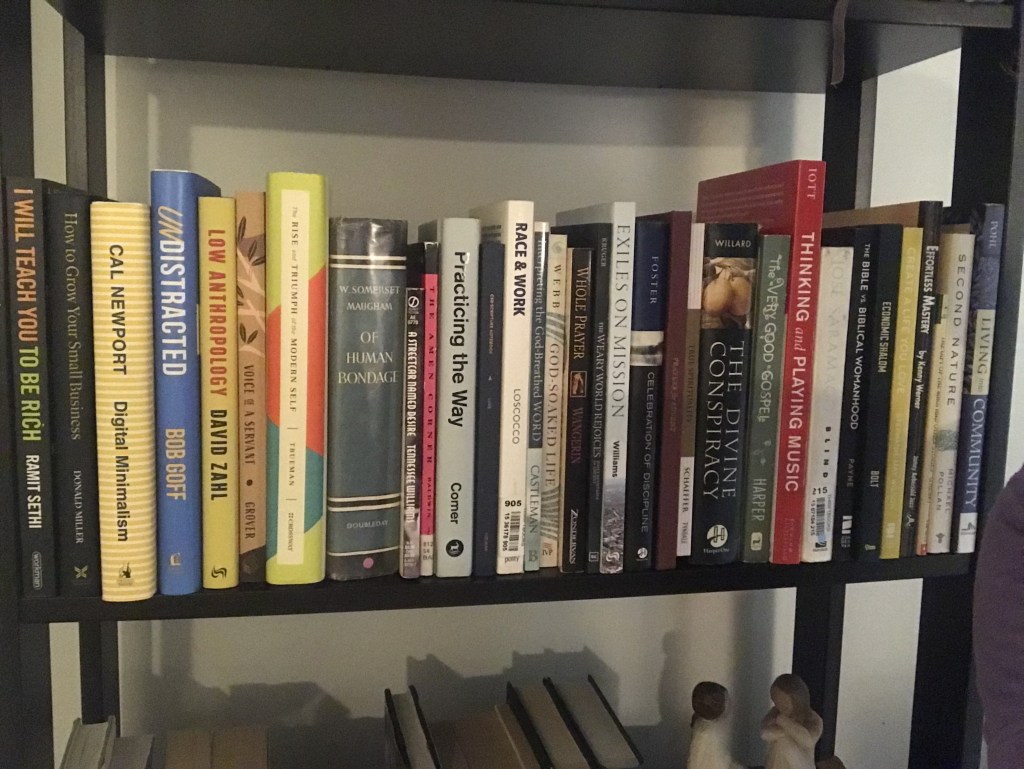
If I had my way, I would own a house with several guest rooms, a massive great room to use for house concerts, and one entire room for the library.
I currently content myself with a bedroom with several musical instruments in it, and a living room with two large bookshelves.
Books have a way of sneaking onto my shelves without being read. Then I see them and their spines mock me. This week, having grown tired of being taunted, I took all of the unread books off of the shelves and gave them their own shelf. It looks like this:
A lot of these books are ones I started or did not finish. Several of them were gifts. A few were free little library finds that I cherish yet have not read. Several of them did not pass the Dark Chocolate Test.
The Dark Chocolate Test comes to us from The Elegance of the Hedgehog, a beautiful and brutal book by Muriel Barbery. The part that comes to mind most often is a little chapter in which Renée, the concierge who never stops reading, says that a book has to be able to pass the plum test before she decides to read it. If the first few paragraphs can overcome the taste of a ripe plum (or, in some cases, dark chocolate), then she reads it.
For me, the books that very often pass the Dark Chocolate Test are fiction. Books with interesting opening lines and well written prose currently intrigue me much more than the books with a foreward, an introduction, and a preface (and yes, non-fiction CAN have all three of those at the same time) So it will surprise no one that nearly all the books on the unread shelf are non-fiction.
And I plan to conquer them. Or be conquered. Really, war metaphors maybe are not the best when it comes to reading. How about this: I am developing my appreciation of non-fiction. We shall see what can grow from the Unread Shelf being read.
For my first Unread Shelf book, I chose The Rise and Triumph of the Modern Self. I chose it for a few reasons. First, someone gifted it to me several years ago when it first came out. At the time, I was doing a fellowship and had little to no time for reading outside of the weekly assignments. Second, the shelf was looking very stuffed, and it bothered me. Third, I felt like if I took one of the biggest ones out first, I would feel better.
(I imagine that the author of this book would have something to say about how I have allowed my sense of self and emotions to guide my reading choices over the years. Well, he might have a point.)
Regardless, I am excited to read this book. And since it didn’t pass the Dark Chocolate Test the first time around, I have invested in a quart of ice cream from my favorite local purveyor of sweet dairy goods. The Rise and Triumph of the Modern Self shall be experienced via the Ice Cream Solution.
Here’s to reading and thinking and writing and making.
I am eight chapters into this draft of my novel and I thought I would take a moment to write about what my current process is like and why I like it.
I wrote the first draft of this (a very ugly draft) for NaNoWriMo (National Novel Writing Month) a couple of years ago. I then proceeded to do a very long draft 0 of it. If I could go back and do it again, I would definitely write that particular draft a lot faster. I labored over it for months, thinking I needed to have this one particular version approach some semblance of perfection. Honestly, I could have just written the scenes I knew I wanted, try linking them together, and see what I liked. That process would have saved me a lot of time.
You write and learn, hopefully.
This draft has been going much more smoothly. I work on 3-5 chapters for a few weeks and then send what I have to my beta readers. This allows me to make sure there’s an overall flow and consistency with the characters and plot.
Questions My Beta Readers Answer
-What’s working?
-What’s not working?
-What should I keep?
-What should I probably think about scrapping?
I wish I had been doing that for the previous draft. Would have saved me from writing a terrible insta-perfect love story involving a melancholic human and a gorgeous, leather jacket wearing, guitar playing faerie (RIP Gabe). Although, they do say to write what you know. And I’d be lying if I didn’t admit that Gabe bears a lot of resemblances to a guitar playing Irishman that I was obsessed with in my 20s. (Can you blame me?)
The best part about this way of writing this draft is that I get a chance to tell myself the story in sections, and then get almost immediate feedback on that section.
This led to a really fun breakthrough the other day with one of my beta readers ( who also happens to be working on a novel). I did my first point of view switch in this last group of chapters and it took forever. I felt like it completely bogged me down whenever I tried to write. I also worried a lot about whether or not the viewpoints felt different enough.
Some writers don’t change their style that much when they’re writing for another character. It’s more what the character notices or what information they convey about other characters or the plot that ends up distinguishing them from others points of view. The prose can often feel almost exactly the same. By contrast, in Spinning Silver, Naomi Novik does this really fun change between several characters’ points of view every chapter and doesn’t even distinguish who is who for the reader. You have to figure it out yourself based on context clues. That’s a lot beyond my reach right now, but I knew I wanted it to feel different enough between the two characters that the reader would notice a shift in tone, focus, and feeling.
During my feedback session, Jared pointed out that there was a lot of inconsistency in one chapter, and then zero problems with tone after that. By going through specific sentences that felt kind of out place, we were able to figure out that I had written one chapter from one POV (Shaelyn, the main character), but I had been using the language of another POV (Jessamyn). Shaelyn’s language is over the top, full of “perfect”s and “awful”s and “sparkly, shimmering slump”s. She is focused on describing her own personal experience and noticing beauty around her. By contrast, Jessamyn is a relationally focused character with far more practical prose.
As soon as we noticed this shift in language, it was possible to pin down exactly where the voice of Shaelyn’s chapter had gone missing. I had been switching back and forth during my writing sessions while working on those chapters, leading to several lines that felt more like Jessamyn in Shaelyn’s chapter. There was also one line in Jessamyn’s chapter that felt very much like Shaelyn (“like butterflies drunk on nectar” doesn’t sound too practical) Lesson learned: always write in one character’s POV for a writing session, potentially for several.
Books and Podcasts for This Part of the Process:
Harry Potter– Re-reading this series as a writer is amazing. Each book really does read like a mystery, and if you know what the ending is, you can work backwards to see how Rowling is doing complex setups and payoffs. It’s a masterclass in how to maintain curiosity and care within the reader across multiple books.
Second Nature-I have just started this and it seems really good. Plus, he has a whole bit about reconsidering the Great American Lawn. I think I love him.
Story Nerd Podcast– Valerie Francis and Melanie Hill are two of my favorite writing coaches today! They do a different movie each week and focus on different aspects to discuss.
Off to map out a fantasy garden and write more chapters! Wish me luck!









 All Things: